

First Impressions Are Everything
Character Introductions

For this week’s rewrite steps, you can skip to the bottom of this post.
How We Met
Marge Gunderson answering the phone in the middle of the night in Fargo, 7 months pregnant.
“Aw, jeez… Be there in a jiff.”
Her husband: “Ya gotta eat a breakfast, Marge.”
Cut to: Marge eating eggs in her police uniform.
Quint scratching his nails on the chalkboard to get everyone’s attention in Jaws.
“I’ll catch this bird for ya, but it ain’t gonna be easy... Bad fish.”
“Ten thousand dollars for me by myself. For that you get the head, the tail, the whole damn thing.”
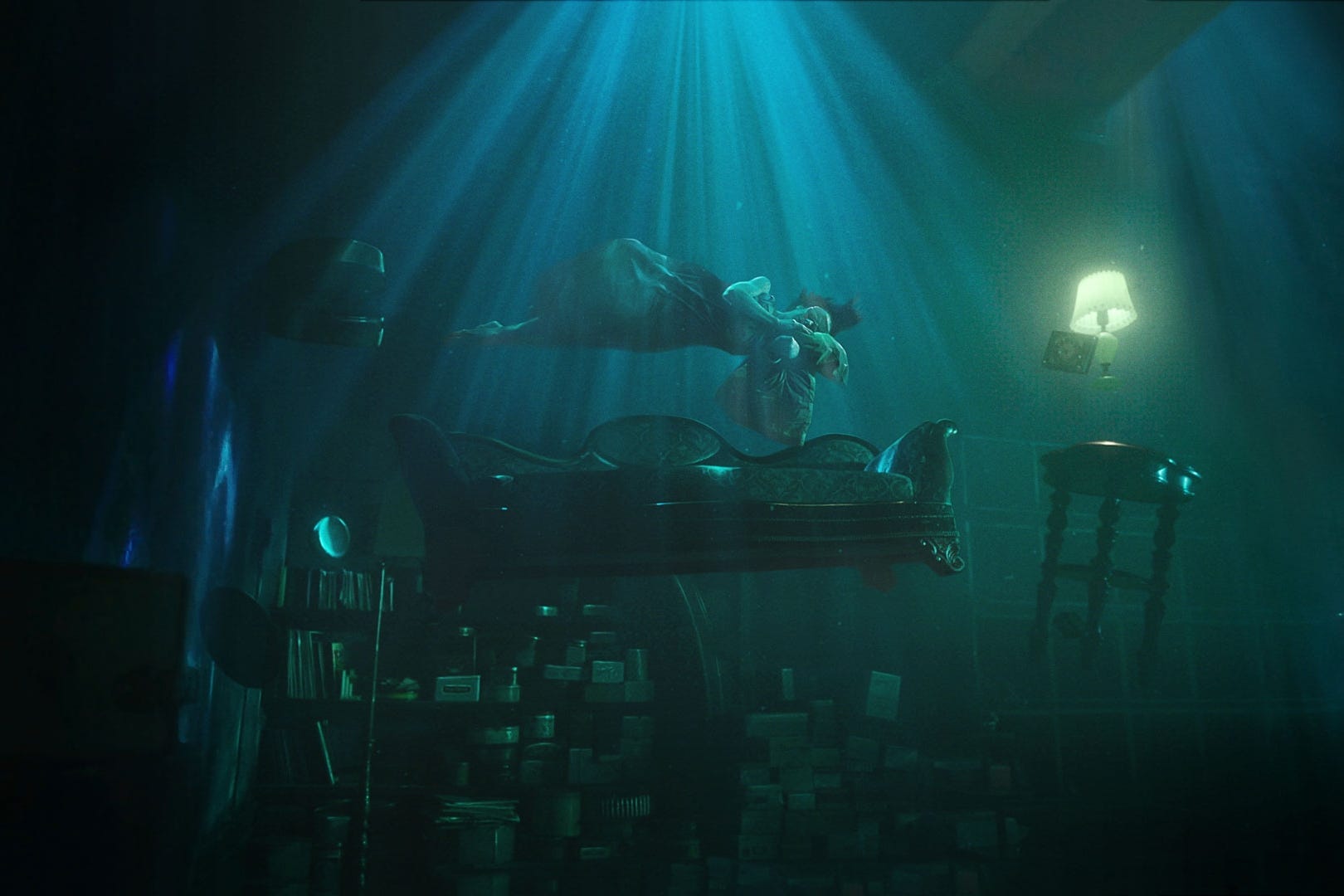
Elisa floating sweetly through her water-filled apartment in The Shape of Water.
Gently landing back in bed just in time for her alarm clock to wake her.
The water is gone.
The way a writer introduces their main character determines SO MUCH.
How we meet a character influences not only how we see them, but often determines whether we can connect to them and if we want to follow them on their journey. Just like in real life, you don’t get a second chance to make a first impression. But the good news is that you can spend as long as you want figuring out that perfect introduction until you get it just right.
And then when you go to do a rewrite, you can revisit it and make it even better.
In scripts, I think of character introductions as two components:
entrance
description
Entrance
By entrance I mean the when/where that you have chosen in order to show the character for the first time.
Are we meeting them as they’re waking up in the morning?
Are we meeting them as the world is caving in on them?
Are we meeting them as they’re delivering a triumphant speech?
Just by being selective of the moment you choose to shine a spotlight on, you can communicate all sorts of key elements about who the person is and what matters to them.
Questions to think about before choosing that scenario:
What is important in their life right now? What is their emotional starting point? Where are they in their life journey?
And then:
What is the most dynamic and interesting scenario I could choose to reveal these things?
In The Shape of Water script, Guillermo del Toro keeps things exceptionally simple:
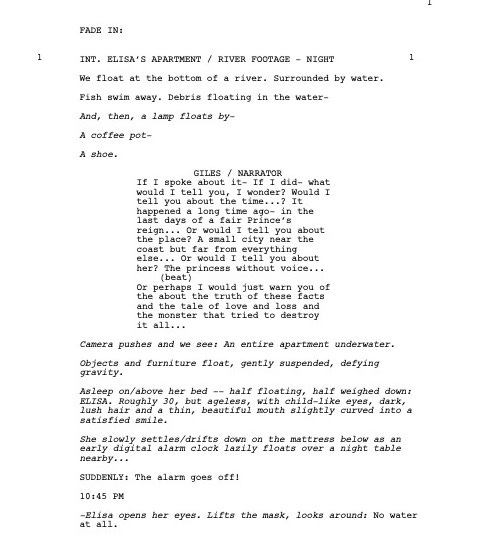
Asleep on/above her bed -- half floating, half weighed down:
ELISA. Roughly 30, but ageless, with child-like eyes, dark, lush hair and a thin, beautiful mouth slightly curved into a satisfied smile.
She slowly settles/drifts down on the mattress below as an early digital alarm clock lazily floats over a night table nearby...
What an entrance. I’m intrigued, are you?
Peacefully floating through an underwater apartment - her character is beautifully tied to water, feels at home in water, dreams of water…
And guess what? That’s directly connected to her central need/want in the story.
So simple, but so effective.
Description
Roughly 30, but ageless, with child-like eyes, dark, lush hair and a thin, beautiful mouth slightly curved into a satisfied smile.
I’m going to give my little speech now about breaking the rules -
People tell screenwriters that there are all these rules you have to follow, one of which is to never write something that wouldn’t literally translate to something we’d see on screen. Namely, no un-filmable flourishes.
Which is total bullshit.
Especially when it comes to describing your main character.
Yes, this is a script and not a novel, which does mean there is a difference in how we communicate information - this is just a blueprint for a film, not the end goal.
But, that doesn’t mean that you can’t ever use your best judgement and add important details that enhance the reader’s experience. These can fill in for the actor’s performance, the director’s direction, the cinematographer’s frame and lighting. I mean… all we have are words, we should use them.
I truly encourage everyone to read the scripts of the movies you love and admire, even if it’s just the first five pages. The more you read the more you’ll see that hardly anyone follows these ‘rules.’
Character descriptions are where screenwriters tend to take the most license, in this regard. You want to find ways to communicate a lot in a very succinct and descriptive way, and that tends to mean getting creative with language.
Guillermo describes Elisa as ‘roughly 30’ but also ‘ageless.’ He is getting after a quality that is felt but isn’t necessarily represented by specific physical characteristics.
She feels ageless when we see her. We can’t necessarily say why.
He looks like a man that cheats on his wife. She moves like a cobra nearing its prey. His eyes contain secrets. Her lips have said many sweet things.
Screenwriters are writers.
Don’t forget that.
Now, let’s get into this week’s installment of the Rewrite Course!
Jump in below or…
… if you’re not ready for a rewrite just yet, check out the first 3 courses in our / Inspired Screenwriting’s screenwriting program that take you step by step through the entire script-writing process, from getting the idea to finishing your first draft:
The Idea, The Outline and The First Draft! You can purchase individually or bundle all three and save .
Previously, on The Rewrite:
If you’re just now joining us, go back and check out steps 1-9 first.
Steps 4-6 - Evaluating Your Map