

"Do I amuse you?"
What makes a great scene? Hint: Joe Pesci being terrifyingly unhinged

For this week’s rewrite steps, you can skip to the bottom of this post.
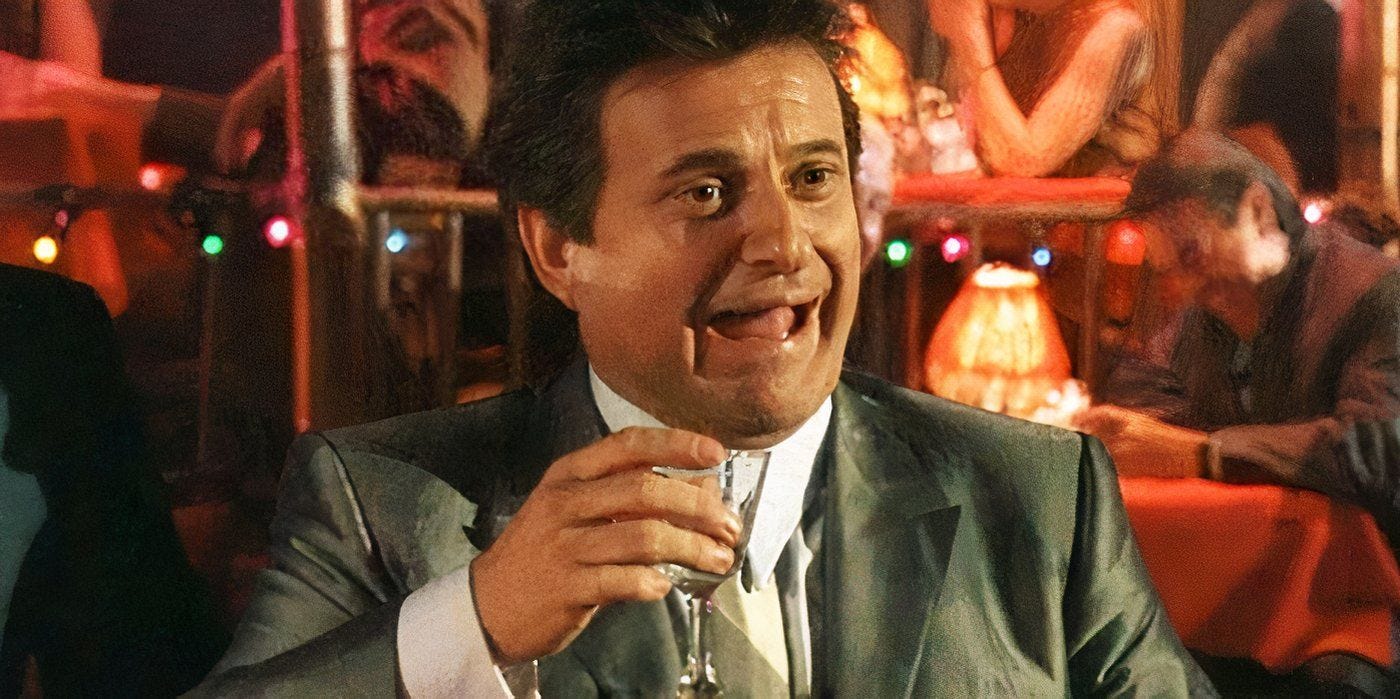
The above scene in Goodfellas is famous for a reason. And it’s not because it has a catchy phrase, or an amazing stunt… it’s because it makes me you feel like something horrible is about to happen in such an intense way that you can barely stand it.
It’s hard for me to watch the whole thing straight even now, even though I’ve seen it a million times.
Joe Pesci feels DANGEROUS. So dangerous that I’m sitting here in my apartment decades later watching on my computer and I’m STILL SCARED OF WHAT HE’S GOING TO DO.
Is it because of his performance? Well, yes, obviously his performance has a lot to do with it. But performances don’t just spill forth from an actor - they are directed. Last by the director, but, I’d argue, first by the script.
It’s the script that places this moment in time, that chooses THIS moment to show, that decides what’s important about this moment, what it reveals about the character and how much and how the other characters react to him.
The Rewrite Course is going to focus on scene work today, so I wanted to look at a scene that gets so many things right. And, yes, I know that a lot of this scene actually ended up being improvised, but the choices made are still made, whether on the page or not, and it shows how effective those choices can be.
Arrive Late and Leave Early
A classic tenet we learn as editors. Almost always when I would edit a scene in the editing bay, the first thing I’d do is chop off the beginning and end. Why? Because there’s usually a lot of ‘business’ there.
By ‘business’, I mean things that aren’t essential to the characters or the plot and are just the mundane workings of life. The ‘hello’s’ and ‘goodbye’s’, the walking across the parking lot into the store, the closing the door when you leave. These are momentum killers and they should always be the first thing to go in a rewrite. After awhile you get so you don’t even bother writing them in the first place, but you’d be surprised how often they can still sneak in even when you know better.
In the Goodfellas scene, we start with Joe Pesci already mid-story, holding court, reveling in the attention. We don’t need his whole story because what he’s saying is unimportant. What’s important is how much he clearly loves being in the spotlight and how his friends are all encouraging him.
We end with a few almost ‘gotcha’ moments. I think of it as like the end of a horror movie. You stabbed the bad guy and then suddenly… HE RISES UP AND CHARGES AT YOU! You stab him again! In the eye! And he dies. You’re safe. But YOU’RE NOT! HE’S ALIVE AND DIVING FOR THE GUN! So you stab him again…
We are so scared of what Joe Pesci might do and we are so relieved when he seems to have calmed down. But then maybe he’s still mad? No, okay, he’s fine. But is he? This reinforces just how unpredictable this guy is, even the filmmaker doesn’t seem to know what he’ll do. Then, going out on that final laugh, reinforces that his friends will not be the ones to stop him, but only to encourage him. Leaving in that moment, we get the sense that the back and forth could go on forever, and his friends will let it, forever.
Imagine then seeing him pay the bill, get his coat, wait for his car at the valet… who cares? What does that have to do with anything? We got what we came for, time to move on.
Three Questions
David Mamet wrote a sort of manifesto about scene work a long time ago and I did a post on it here:

He writes in ALL CAPS and comes off very scream-y but he makes some good points.
The takeaway for me, is that you should be able to ask yourself these three questions about every scene in your script:
Who wants want?
What happens if they don’t get it?
Why now?
In the scene above:
Who wants what? Joe Pesci’s character wants to be the center of attention and have everyone think he’s cool. The people who work there just want to do their jobs and go home.
What happens if they don’t get it? He’s going to go apeshit. Hence the massive amounts of tension.
Why now? First, as far as its placement in the script, this scene happens early in the film around the introduction of the whole crew of guys. It’s vital in establishing the razor’s edge they live on individually and collectively, towards each other and towards outsiders, and how they choose to deal with that level of tension - they laugh. Second, as far as why this happens in the story, in general? We look at who this character is, where is he at in his life? How far to the edge has he been pushed until now? How much has he been denied what he wanted? How desperate has he gotten? How much secret hurt/resentment has he built up? This happens here because he is exactly at the moment in his life where it would. His ranking in this crew, his low/middle level power, his aspirations/expectations for more would inevitably display itself in an unpredictable moment of violence, an opportunity to assert authority over someone he knows he can, bolster how his peers see him.
If nobody wants anything or if it’s not clear? No tension. Flat scene.
If there are no consequences for not getting something? No stakes? No tension. Flat scene.
If there’s no reason for why this didn’t happen ages ago or not at all? No rules governing this world that make some things inevitable? No tension. Flat scene.
CAST
Some last things that are important to remember for scene work:
C
Conflict.
There must be conflict. That doesn’t mean it has to be overt like in this scene, it can be present in the form of an obstacle, a belief, or even one’s own self. The conflict here is obvious, but even a happy love scene, if its a good one, has some conflict looming somewhere in the background.
A
Advancement of story.
Don’t repeat what we already know. Don’t spend time on things that don’t matter. This scene is showing us for the first time who a lot of these characters are and how the dynamics of their group operate. I haven’t seen this yet and the next time I see something like this in the movie, it will build on top of what is learned here, show me how it’s progressing, rather than just repeat it.
S
Setup.
Establishing Joe Pesci’s character’s temperament is key to a major story point later on. Without this scene, later when he shoots a guy for a dumb reason it wouldn’t make sense. If you can remove a scene and the rest of the script plays exactly the same, then it’s missing something
T
Theme / Character Arc.
Where are the characters in terms of their emotional journey? Are they closer to or further away from what they need? Are they accepting? Resisting? How does where they are reflect the theme? As I pointed out above, Joe Pesci’s character is a live wire, trying to prove himself, posturing for others. Henry, goes with it, despite the danger, and then when the danger has passed, pretends like it never happened. Just like he does with this whole criminal way of life. He rides out the sticky stuff and then moves on, makes light of it. It’s how they make it work. As we move forward in the film, Henry’s ability to not react lessens, his ability to move on deteriorates, his ability to keep himself at arm’s length from the insanity is gone.
Now, let’s get into this week’s installment of the Rewrite Course!
Jump in below or…
… if you’re not ready for a rewrite just yet, check out the first 3 courses in our / Inspired Screenwriting’s screenwriting program that take you step by step through the entire script-writing process, from getting the idea to finishing your first draft:
The Idea, The Outline and The First Draft! You can purchase individually or bundle all three and save .
Previously, on The Rewrite:
If you’re just now joining us, go back and check out steps 1-9 first.
Steps 4-6 - Evaluating Your Map
Steps 10-12 - Character Intros, Tone/Genre, World Building